My little hand

My little hand
I want to share this picture, is the hand of my daugther.

sábado, 18 de mayo de 2013

My Personal Research Journey


My topic: How the importance of PLAY in the early years

     As we know “play is essential to development because it contributes to the cognitive, physical, social, and emotional well-being of children and youth”. (Ginsberg, K. (2007).  Play allows children to create and explore the world, practicing adult’s roles, and to negotiate for problem resolution. Physical play helps in their motor skills, communication, and math skills...
I think we need to provide to the children an environment where young children are safe to play and explore at their own place. And let them know to the teachers the importance of play,
Because now a days there are some schools that removed recess of their curriculum and take away the children the importance of play and exploration outside.
This topic that I chose passionate to me ,I want to know more about the importance of play, and why play helps and is importance for the good development of the children, what are some of the consequences in children who do not play.


sábado, 27 de abril de 2013


Final Blog Assignment


  • How important is the first years of life in the children, the strong influence of early experience on brain architecture makes the early years of life a period  of both great opportunity and great vulnerability for brain development.

Early learning opportunities for children from birth to age five have a great impact on a child’s development and build a strong foundation for learning and success later in life.


·         Young children require a learning environment that is warm, secure, and positive, where they can feel happy, healthy, safe, and comfortable. “Children who participate in high-quality center-based programs have better language and cognitive skills in the first few years of elementary school.” (Olson, L2005).


·         A high-quality center based will have:

A rich curriculum: the best early childhood programs emphasize language, emergent literacy, and early math skills, motor, social, and emotional development, health and nutrition services, Play, ( is essential to development because it contributes to the cognitive, physical, social, and emotional well –being of children and young), and parent involvement .

A well-educated staff: Preparation and training teachers.”Young children’s learning and development depend on the educational qualifications of their teachers”

One of my goals is to Advocate always for the children, because they need us to be a loud voice that claim for them and for their needs.

Thanks to all of my colleagues, because each of you shared your experience, your passion, dreams, and goals, to supporting each other growth. Hope all of you to continue learning and grow professionally.

sábado, 20 de abril de 2013

Getting to Know Your International Contacts—Part 3


Early Childhood Care and Educacion


“ IT IS NOT WHAT YOU DO FOR YOUR CHILDREN BUT WHAT YOU HAVE TAUGHT THEM TO DO FOR THEMSELVES THAT WILL MAKE THEM SUCCESSFUL HUMAN BEINGS” Ann Landers.

     Unesco: promotes two useful planning strategies to address the early childhood needs for those under three years of age-phasing and partnership, expand and improve comprehensive early childhood care and education for all.

High Quality childcare, promotes motivation, confidence, good cognitive and linguistic development and school readiness.

For me high quality include good teachers:

·         Being able to create environments in which all children thrive.

·         Building family and community relationships ( good relationships with families).

·         Becoming a professional in the Early childhood field(advocate for children, using ethical guidelines)

One of my personal Goals is to finish this Master in Education to have more knowledge, to learn, understand diversity ,and have the necessary skills to promote a good high quality care and to be a good teacher for all children helping in their development, and in their well-being to be successful in their future, and advocate for them.

Unesco: Promote alternative services for poor children with limited or no access to mainstream early childhood services, Central governments must ensure an equitable distribution of resources especially those who live in the most disadvantaged regions.

Learning, and knowing more for the different organizations that help children poverty , has done it grows in my desire to help and to do something for the poor children.


viernes, 12 de abril de 2013


Ensuring Children Have Quality Care

Save the Children has found that the best way to protect children is to keep
them with their families. And to help caregivers provide them with the right
attention and services. Save the Children supports education programs for
children in the classroom and at home.

  • We train teachers to engage their students through more effective teaching practices.
  • We coach parents and caregivers to help their children learn early on, so they are prepared to enter school.
  • We offer ways for parents and community volunteers to get kids reading and doing math outside of school hours.
  • We introduce children to the power of artistic expression – drawing, painting, music, drama, dance and more – to help them heal, learn and do better in school

In 2011, Save the Children's education programs reached nearly 10 million children, thanks to the many families, teachers, government officials and community volunteers who help inspire these little learners.
 
Early Education gives children an early start that will
resonate through their entire lives.


Jazmine, age 4, of Queets, Washington, and Diverson, age 5 of Zomba, Malawi. Although they live
on opposite sides of the globe, early education, provided by Save the Children, is helping them learn
 skills that will prepare them for school and for life. Follow along as they read, share, play, paint,
color, count and more at school and at home.
This video touched me a part of me,I think that as educators we need  to help children  to develop their skills. For me the only thing that the teachers will need to help the children is the vocation,and the desire to serve them.
 

sábado, 6 de abril de 2013

Getting to Know Your International Contacts—Part 2


Getting to Know Your International Contacts—Part 2

The Global children Initiative.


The Center on the Developing Child has launched the Global Children’s Initiative as the centerpiece of its global child health and development agenda. It also to work collaboratively across disciplines and institutions, drawing together the best and most creative expertise available to achieve the Initiative’s goals.

the global program will focus on three strategic areas:

·         Educated people in  science of learning, behavior, and health, beginning in the earliest years of life;

·         To expand a global understanding how healthy development happen.

·         Building leadership in institutions, Countries  to have more voices that advocated for the children.


The Global Children’s Initiative has begun to build a portfolio of activities in three domains:


 1.-Early Childhood Development. The global dialogue for investments in the early years of life, generate and apply new knowledge that addresses the health and developmental needs of young children in a variety of settings.

Assessing quality in early childhood environments, Piloting assessments to measure child development

outcomes linked to malaria control strategies in Zambia.

 For Example In Chile “A Good Start,” is a collaborative project in Santiago they  improve the quality of educational offerings for four-to-six-year-olds, particularly in the area of language development. This project is also designed to intervene in critical health areas that improve school attendance as well as socio emotional development, and it seeks to involve the children's families in their education.


2,- Child mental health.- a working group of Harvard faculty is developing a focused agenda in research,

education, and public engagement to address significant gaps in knowledge and service delivery.

Assessing the state of child mental health services in China, Developing and evaluating family-based strategies to prevent mental health problems in children affected

by HIV/AIDS in Rwanda, and  Addressing child maltreatment and mental health outcomes in three Caribbean nations.

3,-Children I Crisis and Conflict  Situation,- The Global Children’s Initiative is currently exploring

potential synergies  and to foster interdisciplinary collaboration that incorporates a science-based, developmental perspective into the assessment and management of child well-being in a range of natural and man-made crises, focusing on both immediate circumstances and long-term adaptation.

Bringing strategies for addressing acute malnutrition.

Exploring comparable approaches to surveying child status in post-earthquake Haiti and Chile.


Is Important to educated Educate future leaders, and Provide professional development opportunities people about the development of the children, to know how to help them in some causes of stress, natural disasters ,malnutrition, to be a support for them around the world and to foster good relationships to be involved in the well-being of the children around the world and their needs.

 References:
“Global Children’s Initiative” website (http://developingchild.harvard.edu/initiatives/global_initiative/

sábado, 30 de marzo de 2013

Sharing Web Resources


THE BRAIN DEVELOPMENT

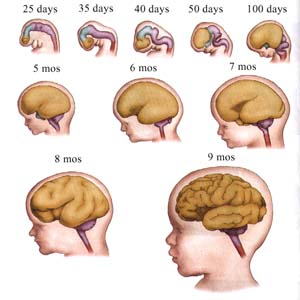
The exceptionally strong influence of early experience on brain architecture makes the early years of life a period of both great opportunity and great vulnerability for brain development.

The first three years of life are a period of incredible growth in all areas of a baby’s. By age 2, the brain is almost 75 percent of adult brain weight, the brain communication system begins with nerve cells called neurons.

During the first months and years, rapid growth and refinement in axons, dendrites and synapses ocour, especially in the cortex for 4 months infants are able to her and listen.

The infant brain development depends on sensory experiences and early movements, every sense functions at birth : they listen, smell, taste, and touch.

Hearing : develops the last trimester of pregnancy (infants turns their heads toward the source of a sound).Seeing: vision is the least mature sense at birth, newborns focus objects between 4 and 30 inches. Smelling: tasting, and touching.

From the first moments of life infants show a preference for human faces and voices and can even imitate adult facial expressions ”emotion sharing” infants experience the quality of their relationships whit others that will has a tremendous impact on how development unfolds.

 
http://www.zerotothree.org/child-development/brain-development/baby-brain-map.html


·         COGNITION AND LEARNING
The importance of talking, reading, and interacting with their toodlers to support development in all brain areas: motor, cognitive, social, emotional and language.

Nurturing relationships and the daily interactions around care giving and free play that exercise a toddler’s brain,

Provide play experiences that allow toddlers to problem solve converse, develop self care skills, engage in gross and fine motor activities, Interact with peers.

·         LANGUAGE

Young children’s brain are very open to the sounds and language patterns, Toodler are indeed capable of learning to languages, they begin life with the ability to hear the differences among the sounds of many languages.

A key requirement for learning language is that it occurs in the context of a nurturing relationship.

Music, sing, dance, promote healthy emotional, social, physical, motor, cognitive, and language development, and offer positives experiences for brain development.


·         MOVEMENT

From 2-3 years is importance that todders practice some skills like: jumping, hopping, climbing ,zipping ,manipulating puzzles pieces, buttoning, using spoon and fork.

As toddlers practice this skills, their movement reinforces the growth of  brain cells and the developing connections between them. You can foster toodlers motor development by providing lots of space, and opportunity for them to engage in fine and gross motor activities, doing this you are supporting the developing of this skills and also the brain development.

sábado, 23 de marzo de 2013

Powerty in China

 CHINA

The Childhood Poverty Research and Policy Centre(CHIP) is a collaborative research and policy programme which involves Save the Children, the Chronic Poverty Research Centre (CPRC) and partners in China, India, Kyrgyzstan and Mongolia. Running from 2001 to 2005, it aims to contribute to global poverty reduction efforts.
CHIP focuses on and draws attention to the ways in which poverty affects large numbers of urban and rural children, not only particularly disadvantaged groups such as street children or child-headed households.


"Over 600 million children world-wide live in absolute poverty - an estimated 1 in 4. In many countries, rates are much higher with over 60 percent of children living in households with incomes below international poverty lines. Over 10 million children under five still die every year from preventable diseases - the vast majority of them in developing countries. As one of the most powerless groups in society, children often bear the physical and emotional costs of poverty. "  (http://www.childhoodpoverty.org/

CAUSES OF POVERTY IN URBAN AREAS

Family poverty impacts on children's health,wellbeing,education, and care.
Mayor causes of family poverty were: unemployment,low income,prolonged illness,low level of education,being over age,the difficult of finding employment,and the hight cost of education.

  • More than half of those surveyed were unemployed.Less than 8 percent of families surveyed had members with permanent jobs, for urban poor families is difficult to access employement-based health insurance and pension ,rural -urban migrants need to pay supplementary education fees for their children.
  • Workers whit low education are likely to be the first to lose their jobs,groups of little education are more prome to poverty.
  • 45 % of poor families provided their childrne with "user pays"vaccination that were not covered by the state -funded immunisation plan, 27,3% has a lack of knowledge of these vaccines,20,9% are inability to pay for them,5,6% belief that there are not important and necessary.
  • Parents are the first teachers of children.Gradparents provided care for their children.
  •  98% of Children from poor Urban families are accessing education, 77.8 % felt because they could not afford to pay education fees.( Migrans that schools fees are heavy because they need to pay additional fees ),but the main reason of children dropping out of school were financial difficults and children's health status.
  • The families with unemployment,poor health conditions,and financial difficults, have  trouble relations with their children.
  • In daily life,family economising means that children's nutrition is relatively poor,and there is little money to pay for new clothes .
  • Mayor causes of family poverty were: unemployment,low income,prolonged illness,low level of education,being over age,the difficult of finding employment,and the hight cost of education.            


http://www.childhoodpoverty.org